Jehan Alain: Difference between revisions
Fiskfan1999 (talk | contribs) minor expansion |
Fiskfan1999 (talk | contribs) m →Editions: imslp ref |
||
| Line 68: | Line 68: | ||
== Editions == | == Editions == | ||
The only publications that were published and reviewed by Jehan Alain during his life were the ''Chorale dorien'' and ''phrygien'', published in [[Le Grand Orgue]] no.57{{Citation needed}} and the ''Trois pieces'' (''Variations Sur un theme de Clément Jannequin'', ''Le Jardin suspendu'', and ''Litanies''), published by Alphonse Leduc in 1939<ref>Alain, Marie-Claire (2003), 10.</ref>. | The only publications that were published and reviewed by Jehan Alain during his life were the ''Chorale dorien'' and ''phrygien'', published in [[Le Grand Orgue]] no.57{{Citation needed}}<ref>{{IMSLP|758747}}</ref> and the ''Trois pieces'' (''Variations Sur un theme de Clément Jannequin'', ''Le Jardin suspendu'', and ''Litanies''), published by Alphonse Leduc in 1939<ref>Alain, Marie-Claire (2003), 10.</ref>. | ||
After Alain's death, the three-volume edition of complete organ works was compiled by the Alain family, working from manuscripts known to them aided by their own memories of how Jehan Alain played his own works. This edition was republished with corrections and additions based on newly-discovered sources in 1951-52 and 1971. Marie-Claire Alain admitted that the 1971 contained some simplifications in registrations that do not correspond to the sources. These simplifications were intended to make registration changes easier for organists, but by the turn of the 21st century, they were deemed not necessary thanks to modern combination actions.<ref>Alain, Marie-Claire (2003), 10-11.</ref>. | After Alain's death, the three-volume edition of complete organ works was compiled by the Alain family, working from manuscripts known to them aided by their own memories of how Jehan Alain played his own works. This edition was republished with corrections and additions based on newly-discovered sources in 1951-52 and 1971. Marie-Claire Alain admitted that the 1971 contained some simplifications in registrations that do not correspond to the sources. These simplifications were intended to make registration changes easier for organists, but by the turn of the 21st century, they were deemed not necessary thanks to modern combination actions.<ref>Alain, Marie-Claire (2003), 10-11.</ref>. | ||
Revision as of 11:50, 26 August 2026

Jehan Alain (1911-1940) was a French composer and organist.
On June 20, 1940, Alain was killed during the battle of Saumur. He was awarded with the Croix de Guerre for his bravery.
Jehan Alain is remembered as one of the first composers to write music suited for the new organs created by the neo-baroque Orgelbewegung movement.[1] He was influenced not only by his studies in counterpoint and composition but by music all around him including Gregorian chant, jazz, and music from around the world.
This article is a stub, you can help expand it with more information and citations!
Works
Two catalogues of Jehan Alain's works are used: the JA Catalogue compiled by the composer himself, and the AWV Catalogue.
Variations sur un thème de Clément Jannequin
Alain's work, also called Variations Sur "l'espoir que j'ai d'acquérir votre grâce". Chanson de Clément Jannequin, is mistakenly titled, as it is based on a work that is anonymous.
Jehan Alain had access to a 19th-century book Échos du temps passé compiled by Jean-Baptiste Weckerlin which contained a piece under this name attributed to Clément Jannequin. This piece transforms the piece into a solo aria with piano accompaniment which is almost identical to the first variation (theme) in Alain's work.
This chanson is found in two publications by Pierre Attaingnant, one in 1529 (in parts) and another in 1531 (reduced to tablature score), both without a composer's name. The attribution to Jannequin is due to a musicological error by Weckerlin, as in 1529 the piece is placed immediately after another work attributed to Jannequin.[2] Previously, musicologists assumed that anonymous pieces found after a piece with a composer's name were all written by that composer; however, this is now known to be an outdated assumption that is not always true.[Citation needed]
On performance practice, Alain wrote in one of his manuscripts, This piece must be played as the Preludes of which Couperin spoke...with freshness and tenderness.[3]
Jehan Alain and Early Music
Alain's music has been interpreted as closely analogous to early music that he heard growing up. In several manuscripts, he wrote about how closely the styles of his own compositions and those from the past were connected.
It should be possible for a musician of the 20th century to preserve the soul of this old music. The language matters little; only the spirit speaks.[3]
Modern music, or at least that which it is convenient to call modern music in 1937, allies itself more directly with old music than with Romantic or Classical music. By the simple game of musical spelling, one ought to be able to pass imperceptibly from one to the other and preserve the freshness and tenderness of music of the 16th century.[3]
1er Prélude Profane
The first Prélude Profane by Alain–also called Adagio or Wieder an–was also written for string quintet (1 violin, 2 violas, 2 cellos).
The manuscript copies of this piece written for the organ survives with many variant readings, especially with regards to registrations and what notes are to be played in the pedal. The 1943 edition of the Alain organ works was realized from one autograph copy that was owned by Madeleine Alain which was considered to be the most similar to how Alain played his own work according to the memory of the Alain family. Since then, more manuscripts have been rediscovered by the Alain family. These manuscripts contained different readings, likely based on performing the piece on specific organs.[4]
Marie-Claire Alain's book on the critical notes of Alain's organ works contains a new edition of this piece based on combining readings from multiple manuscripts to arrive at the most musical solution.[5]
Smaller Works
In addition to grand works like the Suite pour orgue and Trois dances, or smaller works that were widely circulated and published, such as Variations sur un thème de Clément Jannequin, Alain wrote many small pieces. These pieces are generally short explorations of a distinct musical idea. Many of them were written for specific occasions or due to specific circumstances. They show the way that Alain was constantly improvising and writing down musical ideas and expanding his musical world.
Berceuse sur deux notes qui cornent
Alain's earliest known organ work was written in 1929, a Berceuse based on the held notes c# and d#. This was inspired by an incident in which these notes ciphered on the Alain House Organ.[6][7]
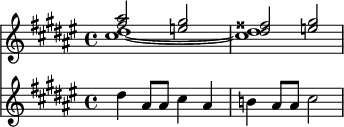
This piece was interpreted by Helga Schauerte as an example of Alain's Humor und Einfallsreichtum (=resourcefulness) as a reaction to the circumstances of his life (such as the cipher in the organ), how he managed to translate these life experiences into the atmosphere of his music, and how his composed music was closely tied to improvisation.[8]
Christe eleison/Amen
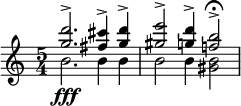
Two improvisatory fragments titled Christe eleison and Amen, found in a manuscript in the Alain family collection, were included in the afterword of the Leduc organ works in 1943 but omitted from later editions.[9]
Christe eleison
Amen

Complainte a la mode ancienne
In 1932, Jehan Alain composed a 16-measure organ piece titled Complainte a la mode ancienne, pour que Poucette joue l'orgue de Valloires (on two staves, including fingering indications) for his sister Marie-Claire, who was six years old at the time.
The piece is written in the style of a Renaissance song in two voices. It is not known wether the melody is original or if it is based on an older piece, such as in Variations sur un thème de Clément Jannequin; parallels have been drawn between the construction of the melody in both pieces. The piece was published in Cinq Pieces Faciles pour Orgue ou Piano by Leduc in 1987.[10][11]

Chorale Cistercien pour une Élévation
Alain's work titled Chorale Cistercien pour une Élévation was originally titled simply Élévation, named for the Elevation during the Mass. The name Chorale Cistercien was created by Albert Alain to combine the piece with the Chorale dorien and phrygien.
This piece survived in one manuscript which was kept at the Cistercian Abbey of Valloires and was only rediscovered in 1951. It was written by Jehan Alain in April, 1934, but it was not included in his own "JA" musical catalogue.[12]
Editions
The only publications that were published and reviewed by Jehan Alain during his life were the Chorale dorien and phrygien, published in Le Grand Orgue no.57[Citation needed][13] and the Trois pieces (Variations Sur un theme de Clément Jannequin, Le Jardin suspendu, and Litanies), published by Alphonse Leduc in 1939[14].
After Alain's death, the three-volume edition of complete organ works was compiled by the Alain family, working from manuscripts known to them aided by their own memories of how Jehan Alain played his own works. This edition was republished with corrections and additions based on newly-discovered sources in 1951-52 and 1971. Marie-Claire Alain admitted that the 1971 contained some simplifications in registrations that do not correspond to the sources. These simplifications were intended to make registration changes easier for organists, but by the turn of the 21st century, they were deemed not necessary thanks to modern combination actions.[15].
Later on, a new edition of Alain's complete organ works was compiled by Helga Schauerte and published by Barenreiter.[Citation needed]
Sources
Manuscripts in F-Pn
The following manuscripts of Alain's works are found in the Bibliotheque Nationale de Paris.[16]
| F-Pn Ms- | Title | Notes | Ref. |
|---|---|---|---|
| 8650 | Grave | [17] | |
| 8651 | Berceuse | [18] | |
| 8652 | Suite pour orgue | Fragment of first movement | [19] |
| 8653 | Tarass Boulba | [20] | |
| 8654 | Piece d'orgue | Also called Petite Piece | [21] |
| 8655 | Prelude et Fugue | [22] | |
| 8657 | Lamento | [23] |
See also
Gerald Woehl Organ, St. Remigius, Viersen, dedicated to Jehan Alain.
Bibliography
Alain, Marie-Claire, Critical notes on the Organ Works of Jehan Alain. English translation by Dr. Normal Stevlingson. Paris: Alphonse Leduc 29422, 2003.
Jehan (Ariste) Alain, "Guillard, Georges," in The New Grove Dictionary of Music and Musicians, eds. Stanley Sadie and John Tyrrell (London: Macmillan, 2001), Volume 1: 268-270.
Hafner, Wilhelm, Das Orgelwerk von Jehan Alain (1911–1940) und sein Verhältnis zur Französischen Orgelmusik des 20. Jahrhunderts. Collection D'Études Musicologiques Sammlung Musikwissenschaftlicher Abhandlungen: Band 92. Baden-Baden: Verlag Valentin Koerner, 2000.
Schauerte, Helga, Jehan Alain (1911-1940) Das Orgelwerk: Eine monographische Studie. Kölner Beiträge zur Musikforschung 137. Regensburg: Gustav Bosse Verlag, 1983. ("Schauerte")
References
- ↑ Schauerte, 9.
- ↑ Hafner, 268-269.
- ↑ 3.0 3.1 3.2 Alain, Marie-Claire (2003), 59.
- ↑ Alain, Marie-Claire (2003), 91.
- ↑ Alain, Marie-Claire (2003), 95-96.
- ↑ Hafner, 25-33.
- ↑ Schauerte, 17.
- ↑ Schauerte, 18.
- ↑ Hafner, 287-291.
- ↑ Schauerte, 115.
- ↑ Hafner, 83-87.
- ↑ Alain, Marie-Claire (2003), 121.
- ↑ IMSLP758747
- ↑ Alain, Marie-Claire (2003), 10.
- ↑ Alain, Marie-Claire (2003), 10-11.
- ↑ Schauerte, 118.
- ↑ catalogue.bnf.fr, accessed 18 August, 2026.
- ↑ catalogue.bnf.fr, accessed 18 August, 2026.
- ↑ catalogue.bnf.fr, accessed 18 August, 2026.
- ↑ catalogue.bnf.fr, accessed 18 August, 2026.
- ↑ catalogue.bnf.fr, accessed 18 August, 2026.
- ↑ catalogue.bnf.fr, accessed 18 August, 2026.
- ↑ catalogue.bnf.fr, accessed 18 August, 2026.